A few random links that I've come across and feel like sharing.
Awesome cartoon from Matt Bors. I especially love the spill/not a spill. I think we're a little past calling it a spill.... time to think of something a little more accurate.
This month the first World Cup in Africa's history comes to South Africa. It's going to be crazy. Want to know how much African's love football? Watch this.
I remember being in Ethiopia and walking into the cafe/bar next door to our apartment when the Arsenal games were on. The place was packed and every eye was glued to the TV; the place would explode when they scored. (H/T to Africa is a Country)
I'm a bit of map lover. I like scoping out surroundings, plotting out locations, trying to remember every country in the world and being able to place it on a map.... that kind of thing. It's a disease. Which is what makes this link so cool. 10 Greatest Maps that Changed the World.
Ever thought of buying a prostitute? No really, some NGO's, churches, random white dudes out there seem to think this is a valid way of helping out. Sounds good in theory but check out this article which succinctly states why it's not at all a good idea. Lesson of the story: Good intentions are not enough.
Speaking of good intentions that ended up with less than savory outcomes, I am reminded of this cartoon:
Just a quick update to the blog so that no one thinks I've forgotten it!
I am knee deep in what has turned out to be the busiest time of the year. Not only are my two final papers due this month (Using Indigenous Knowledges to Decolonize African Universities and Africa and the Black Diaspora: Crossing Borders through Senegalese Hip Hop) and not only do I still have the chapter in the book that I mentioned a while back, but I am now co-editor of said book which is a ton of work, I have another paper being turned into a chapter in another book, AND I have been asked to contribute a chapter to yet another book. Nolana's away in Victoria with Daija visiting it up and it's a good thing because I am putting long, long days in at school.
So, while I am off busy writing and editing here's a fun little link for ya.
The internets are abuzz over Mother Jones' map which covers celebrity involvement in Africa, otherwise seen as the "celebrity recolonization of Africa".
Clink on the link and see a history of celebrity involvement in Africa. The original map (not this screen grab) is interactive and you get to see who wrote a song about which country, who adopted a baby from where, and just how many celebrities go on "fact finding missions".
An excerpt - "Among your characters you must always include The Starving African, who wanders the refugee camp nearly naked, and waits for the benevolence of the West. Her children have flies on their eyelids and pot bellies, and her breasts are flat and empty. She must look utterly helpless. She can have no past, no history; such diversions ruin the dramatic moment. Moans are good. She must never say anything about herself in the dialogue except to speak of her (unspeakable) suffering. Also be sure to include a warm and motherly woman who has a rolling laugh and who is concerned for your well-being. Just call her Mama. Her children are all delinquent. These characters should buzz around your main hero, making him look good. Your hero can teach them, bathe them, feed them; he carries lots of babies and has seen Death. Your hero is you (if reportage), or a beautiful, tragic international celebrity/aristocrat who now cares for animals (if fiction)."
Go read it it all, it's masterful. The Economist on the chances of a fair election in Ethiopia (slim to none). Not only that, the current Zenawi government is propped up by US aid (one of the largest recipients) and Zenawi is championed among the "new breed" of democratic leaders in Africa. Uh huh.
Last election was also marred with violence and arrests, tampering, etc... In my time in Ethiopia I never met a single person in the city who had voted for Zenawi and many of my students had stories about older brothers being arrested, etc... A friend of ours remembers being quarantined to their compound and listening as gunshots echoed through the city. Most people are thinking/predicting this next election will be even more unfair and violent...
Musical Break! Malian Rokia Traore. Not sure if I love the video but I love her music.
I'm a big fan of South African Desmond Tutu, the man is not afraid to criticize just about anybody if they're messing up. That includes Africans who discriminate against gay and lesbians ("Hate has no place in the house of God") and South Africa's ally the U.S., calling the war in Iraq an "immoral war". Speak it brother!
African exports include: Ebola, Madagascar (the movie) and "Apos'trophes t'hat s'erve no' purpo'se".
Musical Break #2! Do you know where Mauritius is? Most people don't and would never have heard music from there - but this last summer at Toronto's AfroFest, Menwar wowed me and here's a clip of him playing at Montreal's International Jazz Fest. We're already stoked about this summer's AfroFest!
Finally, I would be remiss not to mention one of the best blogs about the continent, as well as where I found some of the articles, Texas in Africa. Go check it out.
A collection of various links and stories. From me to you. Enjoy.
The biggest news in Toronto: A Toronto Transit Commission (TTC) worker (he takes subway fares from people) is caught napping on the job. Why is it such a sensation? It's another straw on the fire as people are fed up with the horrible service, rude employees, and fare increases. Most of the ire is directed at the union whose job it is to protect the rude employees who make as much as Registered Nurses or other similarly skilled workers.
Official responses to the story: TTC promises an investigation, the union's only response is to blame the photo taker for not trying to wake their sleeping employee, and said employee actually says on the record, "God bless the Union." Toronto public respond by snapping more pictures of sleeping employees and employees watching videos in the booth. If I had a union who protected me from being fired I might sleep on the job and be rude as well. I for one have personally experienced the outlandish rudeness of said employees though have yet to see a sleeping one - though I often see them doing crosswords or reading the newspaper. Yet another reason that slowly pushes me from pro-union to anti-union...
Remember a while back when I wrote piece on using images of Starving Children in Africa? What, you don't? Well, it seems to be the most viewed page on my blog. I also found a chap who works in Ethiopia that seems to agree with me and wrote a great post on Poverty Porn, check it out.
Want to know more about Haiti's history? Did you know it was the first independent nation in Latin America and the first black-led republic in the world? Check out these two books which I am in the process of reading, The Black Jacobins by CLR James and Avengers of the New World by Laurent Dubois.
I've been following a great blog by a photographer in Liberia. Great photos to check out at Scarlett Lion.
You may (or may not have) heard but there was a recent attack in Angola that left a number of members of the Togolese national football team dead. I won't ask you where Togo is.
As the head soccer honcho in South Africa states: "If there is a war in Kosovo and a World Cup in Germany, no one asks if the World Cup can go on in Germany, everyone understands the war in Kosovo is a war in Kosovo."
Angola is hundreds of miles from South Africa much like Kosovo is hundreds of miles from Germany. Yet another example of how Africa is lumped together as a lawless, violent place that everyone fears.
Coming soon: The World Cup in the land of Nelson Mandela...
Black South Africans may have gained political equality in their country (you may have heard about this) but they still don't have economic equality with the per capita for Blacks being 32 599 rand, while the per capita for whites in SA is 135 707 rand (you won't hear about this).
Though, when I stop and think about, not much of this really comes as any big surprise.
There’s something within me that breaks every time I see a picture a starving African child. It’s normal, I guess, to feel guilt, shame, shock, horror, etc... when I see such pictures. That’s the typical reaction among us ‘decent’ White folk.
This feeling, though, has to be reconciled with the other feelings I feel when I typically see these pictures - disgust and anger towards people or organizations who exploit the stereotype or the image, those who use it as a means to an end.
I’m truly not sure about how to process this reaction and synthesize it all into a coherent response. The images depict an actuality – people die from starvation. There is little doubt of this. And yet there is something more than the picture, something sinister. Images carry meaning beyond what is explicitly presented. Susanne Langer (an art philosopher) said, “A symbol is understood when we conceive the idea it presents.” Much like the symbol of a cross, for example, can mean many things to different people (faith, Christianity, salvation, oppression, death, life), the image of a starving child is more than ‘the truth’. It has come to represent many things: the collective guilt/responsibility/shame of the affluent Western nations (I feel sorry for them), the wealth of the West (you see pictures of people who are obviously not you), the pride/elevation of the West (we have the resources to help), etc...
Not only does the image no longer simply represent starving children around the world (perhaps it once did, meanings change with time), but it has been co-opted by people and agencies as a tool of manipulation and, sometimes, even deceit. In the book, “Road to Hell” a former aid worker documents how the NGO Save the Children markets child sponsorship to the masses, uses false advertising, and spends a large percentage of their budget figuring out how to do it. It’s wilful manipulation.
We can even be threatened with more images, it appears. Whatever the case, it works. Money is spent on research to show this, ad agencies or directors are hired, million dollar campaigns initiated. I can accept that not all agencies are perhaps as wilful in their manipulation but it is manipulation nonetheless.
Now, I understand the argument that goes something like this: We all “know” that children are starving and yet we go about our Western lives, purchasing $5 lattes, $50 meals, $150 shoes, etc... The pictures don’t give us any new information but rather bring home what it is truly like to be starving, or at least what it truly looks like to be starving.
And the truly sad thing in all of this, beyond the purposeful exploitation of emotions, beyond our Western-centric approach, is that there’s truth in this argument. Not in the fact that it is inherently true – I don’t think seeing pictures makes us any more aware of what it’s really like to starve or be around starving people (much like a 30hr famine doesn’t really show you how starving people feel). It’s true in that it does prompt response. The whole grand scheme of exploitation depends on you and me, on our feeling guilty enough to send money, to respond in the right way. A recent quote from Geez magazine has an NGO advertising agent say, “Call it McMarketing; it’s all about supply and demand. You want it I need you. I package it. You buy it. I send you another picture for your fridge that reminds you how good you are. I’m happy to oblige....just remember, I’m only the messenger, and I know how you like it.” Images of starving African children work. Studies show it. People have jobs as advertising directors (and salaries paid by your donations) to manipulate images and words in such a way to provoke a response. Not an intellectual response but an emotional one.
And this is the final thing that frustrates me. The only appropriate response to such an advertising campaign, we are told, is to donate money. $40 feeds a child for a month, $100 sends him to school, $50 buys a sheep. Donate now! This approach ignores why the children (and the rest of the people!) are starving. It ignores the globalization of trade, the subsidies paid to Western farmers to ensure we can buy sugar, bread, coffee, etc... for cheaper prices, the increased costs of production because of the introduction of Western fertilizers and pesticides. It ignores the exploitation of the disadvantaged. It ignores the system in favour of treating the symptoms. For however much Bono campaigns for debt relief, for however much organizations raise for disaster relief or fresh water (and it’s not to say that these aren’t good things) – for however much we donate – it ignores the bigger issues.
Not only that, our donations seem to exempt us from having to confront these issues; it assuages our guilt enough to help us continue with what we were doing before. We need to stop blindly submitting to the propaganda (harsh word, I know) and actively question the systems that we are a part of, the system of domination and exploitation, the systems that lead to people starving. But this system of images and donations stupefies us, silences us, and renders us immobile. Our donations are so insignificant in the scheme of things. Governments give more than what is privately donated through NGOs. Remittances (relatives sending money back home) bring more money into Third World nations than Western governments. Trade brings in even more than this. This is my frustration: the images are part of a system that satisfies us with cheap, easy answers without solving anything.
These issues are huge; the books written about them could fill a library and a blog post can’t even begin to summarize them (even if it is a long one like this one!). An image is never just the picture, never just the revealing of a moment of time, never just what you see. It can’t reveal everything (it’s limiting) and yet it has endless possibilities through symbolization. It’s powerful.
I was at church the other night and we were shown a video. The background narrative was a sermon on taking action, on going into the nations. The images, every single one of them, were of African children. It carefully placed images of starving children at the right times (to make a point about how bad things were) and juxtaposed them with pictures of happy, smiling African children (to make a point about how good things could be).
People starve the world over. Gypsies in East Europe. Elderly in Latin America. Mothers in Africa. Children in North Korea. And yet, they are not shown. They don’t carry the same weight, the same meaning, as African children. We all (and please note, I certainly include myself in this) accept this barrage of images as the norm, accepting guilt and pity as the best we can do. The system continues on. Pictures flood the TV. Every week more mailings arrive with pleas for aid. The pictures are like currency, you can bank on it. What are we going to do?
This picture is from an ad for Health Care services and makes me chuckle whenever I see it.
But it's true as well, not only from a beauty or reproductive point of view.
In Africa and other developing countries there has been a push to target aid initiatives towards women because, not only are they often marginalized in their locations, but also they are much more adept and using the aid to assist their family and sustain development.
I guess the world does need women! (Really not much of a shocker from my perspective.)
An excellent comparison article over at FAIR (Fairness & Accuracy in Reporting) over the level of coverage of crisis' in Africa. You've all heard about Darfur - but do you know what's happening in the Congo? The article is here. And an excerpt:
“… The most recent survey [by the International Red Cross] estimated that 45,000 [Congolese] people are dying each month from conflict-related causes (primarily hunger and disease), nearly the same shocking rate as during the war itself. And with the recent flare-up of violence in Congo’s volatile east, things don’t seem to be getting any better. To put the death rate in perspective, at the peak of the Darfur crisis, the conflict-related death rate there was less than a third of the Congo’s, and by 2005 it had dropped to less than 4,000 per month. The United Nations has estimated some 300,000 may have died in total as a result of the years of conflict in Darfur; the same number die from the Congo conflict every six and a half months. And yet, in the New York Times, which covers the Congo more than most U.S. outlets, Darfur has consistently received more coverage since it emerged as a media story in 2004 (Extra!, 1–2/08). The Times gave Darfur nearly four times the coverage it gave the Congo in 2006, while Congolese were dying of war-related causes at nearly 10 times the rate of those in Darfur.”
It's interesting to wonder at why some things get the coverage they do. I guess they just catch our attention and once they do the media wants to feed us what we know about. I remember thinking the same thing when the pirates in Somalia caught the world media attention. They've been hijacking boats for years and then all of a sudden, for some reason it became a big story that everyone was talking about. The media is a monster that we feed.
There's no reason to not know what's going on in the world around us. If you want to know more about what's happened in the Congo, an good book to check out is Howard French's A Continent for the Taking which focuses a fair bit on his experience in the Congo in the late 90s.
405,000 died from TB 182,000 died from measles 69,000 died from tetanus 1,417,000 died from respiratory infections 27,000 died from iron-deficiency
And yet, somehow, we are in a state of emergency over a flu that has killed no one in Canada yet. The lesson is learned: all you have to do is threaten a white, affluent North American and every precaution will be taken. Threaten to kill thousands of Africans and the world sits on their hands.
Just sharing a short documentary on one of the most impressive African groups around, Tinariwen. They are made of Touareg nomads and have melded an electric American blues style with traditional Touareg rhythms. They bring real life events to their music: rebellions, human rights issues, etc... and still sing in the traditional Touareg language. They are certainly not mainstream but, for those who are into great music, they hold some serious cred (Chris Martin of Coldplay acknowledged their influence on Viva la Vida). Their most recent release is Aman Iman (Water is Life) and is a great album.
The clip is 17 minutes long, but well worth the watch. Enjoy.
As you may (or may not) have heard, the Pope is currently on a tour of Africa and has followed in his precursor's steps by confirming that the Catholic church is against the use of condoms - and that, in fact, condoms are contributing to the spread of HIV/AIDS in Africa.
Let me say a couple things. The Pope is absolutely correct when he says the only sure-fire way to stop HIV/AIDS is abstinence. He is also 100% correct when he says that condoms alone will not stop the tide of HIV/AIDS.
But there are far more things that he is simply turning a blind eye to. The first and most important is this: Abstinence is a good idea but it is simply not reality for most people. The goal of faith communities should be to engage with the real world. Caedmon's Call (on an old old album) had the lyrics, "How can I preserve and light the way for a world I can't admit I'm in?" People are having sex with multiple partners, Catholics are having sex with multiple partners - heck, even some priests are having sex with multiple partners. That doesn't mean it is right, but it is most certainly reality. For those who preach abstinence as the only way to attack HIV/AIDS, they are closing their eyes to reality.
I don't believe condoms are the answer to HIV/AIDS. I don't believe there is one answer. We must piece together many prongs of attack of which condoms is one that has proven to work in some situations. There has been tons of work with condoms in Africa and despite some serious deficiencies, the work has certainly helped people stay HIV/AIDS free. For someone with the clout of the Pope (or the President) to come out and say condoms are a sin seriously hampers the good work that is going on in Africa with condoms. The Pope has, by what he said, most certainly caused someone in Africa, this minute, to be infected with HIV - someone who might have used a condom except that the Pope told him on the radio that it was wrong.
It frustrates me to no end when I hear respected leaders spout off about what is right or wrong for people in Africa - especially when what they say is in direct opposition to the facts. It makes me even more upset when these leaders use God to gain currency for their ideas.
At the bottom of the CBC article there is space for people to comment. The highest rated comment on this article was, "Organized religion is the worst thing to happen to God." I clicked, Agree.
HAPPY NEW YEARS!!! (have to get that out of the way)
This is likely to be a real scrambling of ideas and thoughts - so be warned.
2008= a good year. I kicked it off by celebrating with my wife and a solitary friend on a balcony in Ethiopia, smoking a cigar, and ended it with family and a lovely little daughter in wintry Calgary. Pictures from our delightful holiday season can be found on Facebook here. I am simply too lazy to post them here again.
2009 = more unknown. I am currently taking a break (heck, actually I haven't even started, but I've been trying) from finishing up my first Masters application (of two) and hopefully 2009 will be the year of jubilation as I get accepted and finally see the first glimmer at the end of the education tunnel. We'll be out of Victoria again, still in Canada though, and still dreaming of Africa.
African news: Ghana has a new President and a seemingly 2nd peaceful transition of power. You only hear of coups and wars in Africa - but in some places, progress is happening unheralded. Go check it out.
Also an interesting article that a friend passed along (thanks Gill!): an atheist writing that Christian missionaries are good for Africa. You can read it here. I am a little torn on reading it. I believe that Christ is indeed the hope of the nations, not just Africa. Yet, the tone of the article irks me a bit; as if for some reason Africa needs faith because of.... their backwardness? Their history? Their inability to get along? Their mob mentality? Whatever reason they need faith, the writer doesn't seem to have that same reason. I applaud the honesty of the article, the seeking and openness, but wonder if it is nothing more than a poorly thought out observation. Christianity and missionaries have failed so many times in Africa and in large part because they didn't take the time to think out the implications of their actions. They had good intentions (at times) but failed in Christlike qualities such as justice and mercy. The article seems to follow in this good intentioned yet oblivious vein. Other things, like the image of NGO workers debating strategies in tourist hotels, strike a chord but... from experience I think it has more to do with the person (and their motivations and convictions) than their faith as to if this is true. Anyways, definately a thought provoking article. Anybody else have thoughts after reading it?
Back to us: New Years resolutions: find more time to read rather than being computer dependant, lose some of the 1000+ plus lbs I've gained since Ethiopia (everybody has to have a weight resolution, right?), become more sensitive to insensitive people, keep questioning the things that need to be questioned and trusting in the one who is unchanging to guide my wanderings.
For most people, you'll never get a chance to dig into the amazing myriads of music that comes out of Africa. If you have it's likely been some of the classics like Fela Kuti or Ali Farxe Toure, or perhaps some of the more accessible South African bands and choirs like Ladysmith Black Mombaza or Soweto Gospel Choir.
Today on Eric's wanderings I present a few samplings of modern African music from a variety of genres to make you smile, make you tap your foot, and just maybe, make you go check out some more. Most of them are not very well known in North America or maybe even outside of their countries. But all way cool.
First off, some Nigerian folk/pop in the vein of Tracey Chapman or even a little Jack Johnson type rhythm. Asa (Asha) is a fairly new artist and this is her song, "Fire on the Mountain."
The next selection is from a famous Senegalese/Moroccan drummer, Mokhatar Samaba off his new album Dounia, which is also the title of the song. It starts off with a recording of the famous Archbishop Tutu. Check him out.
Next up is something very different and way cool. The band is Tinariwen and they are a Tuareg protest group recording in their native Tamasheq. They play in their local styles and rhythms, mixed with some blues. The Tuareg are the bedouins of the Sahara and this group formed in a refugee camp and has started making the world take notice of their culture and their people's plight. Check out the song, "Chet Boghassa".
This one makes me just want to smile and bob my head every time I hear it. A collaboration between 113 from Algeria and Magic System from Cote d'Ivoire. It's hip-hop with a fun, African twist. The part around 1:54 always makes me laugh! Check it out, "Un Gaou Oran".
Lastly, some very cool cats from South Africa. If reincarnation could be real I would probably choose to be one of these guys. BLK JKS from Johannesburg, some psychedelic, African inspired rock. Taking a look at this video, some day I want to be at a show like this... Check out "Summertime" here.
Well, that;s it for now - maybe at some point I'll do it again. Tell me if you enjoyed it, if you skipped through it because there were no pictures of my baby, or if you want recommendations. Peace all.
Recently, the only active volcano in Ethiopia (Mt. Erta Ale) erupted. It's in the Danakil Depression which borders Ethiopia, Eritrea and Djibouti (for you Ethiopia neophytes - think East). The Danakil is the lowest point in Africa (500 feet below sea level), one of the hottest places on the continent, and where they found Lucy.
Some friend of ours in Ethiopia sent us this picture. Enjoy!
20 Doctors graduate in Somalia for the 1st time in 20 years - and the great thing is the grads did it through decades of turmoil and will likely only be able to practice in Somalia... that is dedication! Check it out here.
Rick Mercer writes a wicked blog on the coalition talk. Check it out here.
An article on Bush's post-presidency plans - hard to redeem a legacy like his! But he plans to try by building a Freedom Institute that he proudly acknowledges will be "non-academic" because Bush never really liked academics (intimidated likely) and only people who line up with Bush's views need apply to help out. Seriously. Check it out here.
I found out one of my relatives (like 3rd cousin) was one of those who died in Afghanistan, number 54 of a total that has now reached 101. He was Joint Task Force and died in an accident. You can check out the story here.
And, finally, You can find out how your food feels before being eaten here.
Propaganda is: Material disseminated by the advocates or opponents of a doctrine or cause.
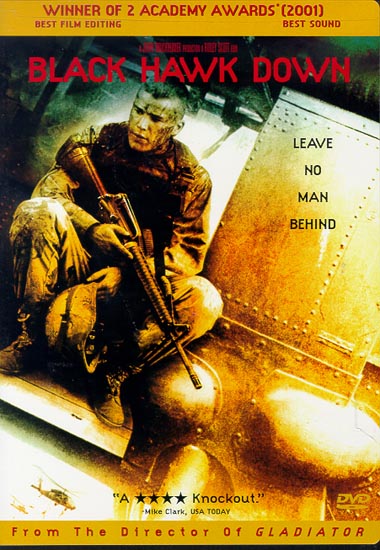
I remember the first time I watched the movie Black Hawk Down. It was quite a popular movie and when it opened with the setting of Somalia I vaguely tied to to Bosnia, Chechnya, and other war torn areas in the news and ending with -ia. I remember thinking how valiant the soldiers looked in the middle of horrific battle. These 19 men died for freedom, for helping others.
Now I watch the move (as I did this morning) and wonder at what a masterful job the creators did of shaping a piece of propaganda meant to shape the way we see a certain event in history.
Two times in the beginning monologue they refer to the U.S. troops "restoring order" in Somalia with their presence. Or as this order restoring was earlier called in Africa - pacification. The killing of whoever represented a threat to 'security'. And casualties be damned. An American sense of security must be restored to a vital region. Vital to American security concerns. Anything so we can be 'secure'.
The events of Black Hawk Down are inextricably tied to the following Rwandan genocide. Due to the loss of life during operations in Somalia the U.S. was understandably a little more reticent to send in troops to another African country intent on self-imploding. So they sat back and watched the genocide happen, all the while refusing to call it a genocide, because if it was indeed a genocide they would be required by UN sanctions to intercede. They did not call it a genocide and did not intervene.
So at the beginning of this movie one of the Somali's tells an American, "It's a civil war, there is no place for you here." And all self-righteously the American responds, "No, it's a genocide."
It was not a genocide, it was indeed a civil war and remains so to this day. And yet the movie makers needed, in light of Rwanda, to insert this comment to show that Americans take this oh so seriously. That they're not afraid to intervene in a genocide. Somalia and Rwanda are tied together by these events and you, in your Hollywood movie, toss around genocide in attempt to ease your national conscience and to get people to believe that you actually care about what happens in Africa.
Alright, so maybe I'm a little tight about the whole thing. I actually found the movie a little hard to watch this time around. I had to stop part way through, give myself a break, and then keep going. The war in Somalia still rages. Mogadishu is still a ghost town torn apart by daily violence. And now the U.S. is involved again... in a safer way. They don't want to lose more American boys so they arm Ethiopians to go in and 'defend democracy'.
I remember talking to a Somali man I met in Ethiopia (there are many who have fled the country) and he talked about his family, his life there. Nothing profound. Except that this man now had no country to return to, no place for his family to be safe. This was real. It was not just the rabid crowds you see in the movie, attacking the soldiers who are there to help them. It is the pent up anger of decades of American interference, of civil war, of the inability to escape violence. All this, affecting real lives like yours and mine.
And yet, for all that most people know, it's just like they show it in Black Hawk Down. US Boys dying for human rights, fighting against the barbarian horde.
I have been watching as much of the Olympics as I can, simply because CBC.ca is streaming a ton of it online. Not having cable means I don't get to watch too many sports so this is a glorious opportunity. Seriously, go check out CBC.ca, 9 channels of streamed Olympics.... though some of the channels the video quality is so-so.
Leading up to the Olympics there was a lot of talk about boycotting the Opening Ceremonies due to China's lack of human rights in 2 areas (primarily): Darfur, Sudan and in Nepal. George Lucas pulled out of aiding production due to Darfur connections that China had. Bush condemned China on his way to attending. And all this made me think...
How many times has the USA been involved with or had business dealings with corrupt, human rights smashing governments in Africa? The answer is: too many to count. From the DRC to Angola to Equatorial Guinea to Nigeria to Congo/Brazzaville to Ethiopia.... the list goes on. What a double standard! They are just upset that someone else has figured out their tricks and is using them to battle them for power! (also see: Georgian conflict)
The Chinese in Sudan have invested large sums in drilling for oil and this money goes to fund the militias, etc... that perpetrate the killings. The US has done similar, or just plain gave the money, to more than a handful of equally dastardly governments in Africa. And often for the same reason: oil. I just finished reading Untapped: The Scramble for Africa's Oil and I highly reccomend it, even if you aren't into current events reading it is a highly enjoyable, easy reading. My From the Books doesn't actually come from this book but from one by the great Orientalist Edward Said. It's rather lengthy, so now that you've ready my rant, you can safely scroll through without hurting my feelings.
"The United States is in fact repeating the practices employed by the British and the French in the nineteenth century. The big differences are, first, that today we [the US] are capable of much greater destruction than they were, and, second, they we are unable to state openly and candidly our engagement in the business of empire, and damn the results. The counter to this anachronistic and dishonest line is.... starting immediately to dismantle the imperialist mission that the United States has set itself from the beginning as a nation....
The first step is to remove the taboo that forbids Americans to regard their country's actions as imperialist. Then what we must do is learn to live like other people.... since ours is a precariously balanced world, with ecological, economic, and social pressures that are barely containable,
it is sheer folly to suggest that we are naturally entitled to cheap oil or to a better way of life than anyone else. Or that we can survey the world and decide whom "we" regard as punishable or not.
That we have military power to enforce these often petulant, not to say narcissistic, desires makes things a great deal worse. The Gulf [or Africa] is not merely an empty desert with a large pool of "our" oil underneath and a whole bunch of sheiks, terrorists, or Hitlers on top, but a place with living people, traditions, and societies whose aspirations and values have to be viewed as having merit independent of our needs and attitudes.
The history of American interventions over the years has not been salutary, to say the least.... We are insulated by our wealth and our immense power."
"Humanitarianism is about the struggle to create the space to be fully human"
"At its best, politics is an imperfect human project. It is at its worst when we delude ourselves into thinking it can be perfect"
"Today one of the greatest challenges facing humanitarianism is the blurring of boundaries between humanitarian assistance and the political objectives of military intervention"
I recently just watched the fantastic movies Sometimes in April and Shooting Dogs which chronicle the 1994 Rwandan genocide in all of its infamy. If you've seen Hotel Rwanda... I pity you because that is Hollywood. These movies are a much better account, I especially encourage you to check out Raul Peck's Sometimes in April though I warn you it's not an easy movie to watch.
All this got me thinking about how we, as white Westerners, view Africa and the genocides that occur there. Hotel Rwanda was a hit movie. Books such as We Wish to Inform You That Tomorrow We Will Be Killed With Our Families remain on the top of Chapters and Amazon African best-seller lists (which is not that prominent a list!). There is a big push to know about Rwanda.
I highly encourage people to know about it but I wonder what good it is doing. The recent report is that more than 300,000 have been killed in the genocide in Darfur. Since the downfall of the government in Somalia in the early 1990's hundreds of thousands of died. In the DR Congo. In Ethiopia. In Zimbabwe. In many African countries thousands have died from armed conflict or what we would likely deem 'terrorism' in the West. In South Africa alone 1.8 million people have died from AIDS, according to UNAIDS latest report.
And yet all we can seem to muster is a few books to assauge the guilt of a genocide that occured 14 years ago. It's great to learn about Rwanda if it inspires you to make sure it never happens again. And yet it has taken 3 years for the international community to condemn Sudan's president of war crimes in the genocide there. Nothing has changed. We belatedly believe that watching Hotel Rwanda makes us better people and somehow assures us that it will never happen again. Let me tell you, it IS happening again as we speak in African countries across the continent.
At one point in Sometimes in April one of the US government civil servants who is struggling with the US/UN inaction asks, "Is it because they're African?" When 5,000 Americans die in New York it not only makes news but creates 2 wars. When Canadian soldiers die in Afghanistan it never fails to make the news and parades are held. There is a distinct difference between how wars in Africa are treated and wars in the West. Maybe it is because they are Africans...
What will it take for us to rise up as nations and say this is not acceptable? That lack of ARV treatment for AIDS is not acceptable? That people dying for lack of clean water is not accessible? That nations standing by as systematical genocide is implemented is not acceptable? The sad answer is I don't know, I can't see that line...
 Awesome cartoon from Matt Bors. I especially love the spill/not a spill. I think we're a little past calling it a spill.... time to think of something a little more accurate.